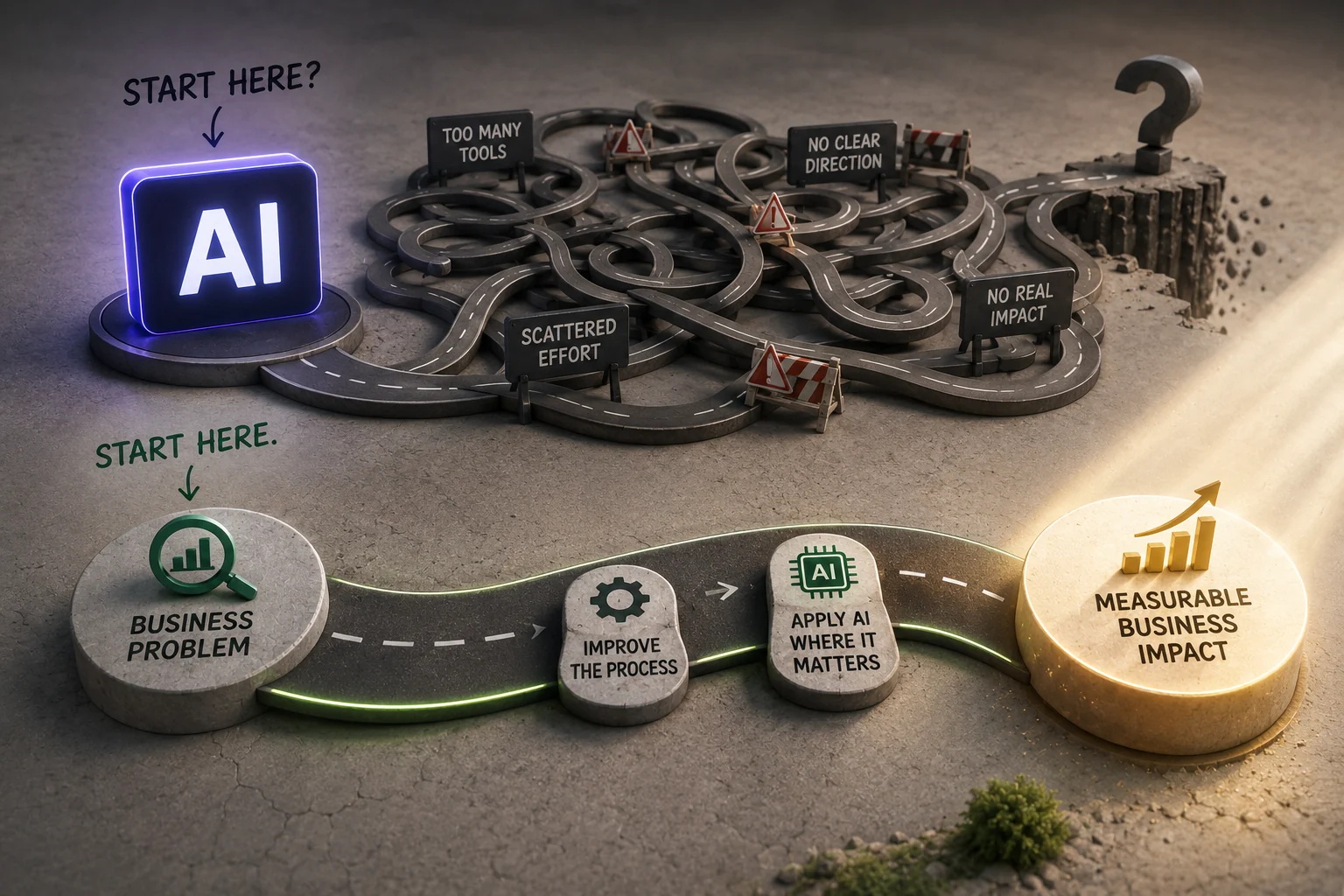
Almost every business starts its AI journey in the same place.
Someone signed up for ChatGPT. Another team wants to try Claude. Someone else has heard good things about Gemini. Before long, the conversation becomes about models, subscriptions, and features.
It's understandable. New technology naturally makes people curious.
The problem is that comparing tools is usually where the conversation begins—and sometimes where it ends.
A much better place to start is with the business itself.
Where do people spend most of their time? Which tasks are repeated every day? Which processes slow projects down? Where do employees find themselves copying information from one system to another or answering the same customer questions over and over again?
Those questions often reveal far bigger opportunities than choosing between one AI model and another.
Every business has work that feels necessary but doesn't really create value. Preparing reports. Summarizing meetings. Searching for information. Writing the same emails. Updating spreadsheets. Individually, none of these tasks seem like a problem. Together, they consume hours every week that could be spent serving customers, improving products, or growing the business.
That's where AI usually delivers its biggest wins.
Not by replacing entire departments or transforming a business overnight, but by quietly removing the repetitive work that gets in everyone's way.
The businesses seeing the best results with AI rarely adopt it because they want to "use AI." They adopt it because they've identified a process that could work better. AI simply becomes one of the ways to improve it.
The opposite is also true.
Businesses that start by chasing the latest tools often end up running lots of experiments without changing very much. One team uses one platform, another team tries something different, and before long there are several AI subscriptions but very little impact on how the business actually operates.
Technology works best when people don't have to think about it.
Most employees don't wake up hoping they'll get to use another AI tool today. They want to finish their work faster, spend less time on repetitive tasks, and focus on the parts of their job where experience and judgment actually matter. If AI helps them do that, they'll use it. If it creates more complexity, they probably won't.
That's why successful AI adoption has much less to do with choosing the perfect model and much more to do with understanding how work already happens inside the business. Once that becomes clear, the technology is usually the easy part.
The businesses that get the most value from AI aren't necessarily the first to adopt it. More often, they're the ones that understand their own processes well enough to know exactly where AI can remove friction without creating new problems.
← Back to Resources